Monday, 8 December 2014

Music Video Review: Recognise By PARTYNEXTDOOR


Jahron Anthony Brathwaite (born July 3, 1993), better known under the stage name PartyNextDoor (often stylized as PARTYNEXTDOOR), is a Canadian singer from Mississauga, Ontario, who is signed to Drake's OVO Sound record label. The song includes celebrity cameos from the likes of Kendal and Kylie Jenner.

Unlike most Hip-Hop videos the song does not feature many low angled shot which subverts the assumption that this is an occurrence in most hip hop videos. However the video does adhere to the theme seen in most Hip-Hop videos that the video gives the artist dominance over the audience as they are important enough to have the frame to themselves. 

This is done by the countless shots demonstrating the lavish lifestyle the artist live as seen by the screen shot of PARTYNEXTDOOR seen to be on what looks like a yacht accompanied by some very attractive models.Which brings us to the next point of the way women are portrayed in many (if not all) music videos. In a report it was shown that Rap and Hip-Hop in particular, were guilty of presenting women in a sexist way, often as "commodities" and sex objects. 

Unlike some forms of media for example film and television have the right rules and regulations of what is allowed to be seen and by what audience it is allowed to be seen by. Music videos however are very little legislation what is allowed and what is not. Meaning that there are very many artists getting away with degrading women and who's video is more outrageous. In the screen shot above we can see that there are many frames with women are used as "eye candy" and to show how "desired" PARTYNEXTDOOR is; it also has connotation that women are irrelevant and meaningless.


Another stereotype that this video adheres to is the fact that is in music videos there are always crowd usually shown in various cameos and the effect that it has it gives the artist that same sense of desirability that having beautiful ladies in the video does. This makes the artist/artists look as if they are actually dancing to the song, which usually gives the impression that they like the song and that the song is something they may not be able to relate to but they can enjoy. 
This gives credibility to the song/artist, because it demonstrates that people do like the song, which makes it easier for the audience to like the song as if they see people enjoy the song they feel like they need to join the trend and will usually end up liking the song as well.

In terms of the clothing used in Hip-Hop videos are generally basketball shirts or other sporting attire saw as well as exclusive designer brands and hoodies. The effect of this is to pursue strength and sporting prowess, something supported by physical workouts in music videos. Expensive jewellery in videos usually signify or imply lots of references to the wealth of the artist through the use of mise-en- scene (money, cars, jewellery etc.). Expensive things signify wealth, which supposedly signifies status.

Wednesday, 26 November 2014

Music Video Review: Loyal By Chris Brown


The song was produced by Nic Nac and features guest appearances from fellow rapper Lil Wayne and rappers French Montana, Too Short or Tyga, depending on the version of the song. Chris Brown enlisted Lil' Wayne and French Montana for his new track, "Loyal." The single opens with Weezy rapping about his lack of trust in his female companions. Chris Brown joins in, commenting on the gold-digging tendencies of women he knows, repeating a chorus of "These h--s ain't loyal." "Loyal" is expected to be featured on the controversial singer's upcoming album, "X." Due out in 2014, the record may be Brown's last.

The use of the camera is the most effective way to portray meaning by the use of the different camera shots, angles and movements. As an example, the low angle shot of the artists standing in the crowd can make them seem dominant over the audience and on the other hand a high angle would make him seem weak.However that is not the mood Chris brown wants to convey here. Other shots such as a close up on the artists face can be used to clearly express emotion of happiness through the frivolous spending we can seen in the outfits they wear along with the accessories like the flashy chains used to show wealth without having physical piles/stacks of money adhering to the stereotypes but this is done very narrowly. 

“These hoes ain’t loyal.” I wake up too many mornings with the hook playing in my head. Here’s the kicker: And yet I can’t get it out of my head right now because it’s stuck on repeat. So, the fact that this song won’t leave me alone, means that I need to write about it. A hoe is a thing; it’s an object. It is a tool to be used. It is easily discarded and replaced. So, when we sing along to the catchy beat, we subconsciously accept that women and girls are things. We accept that they are disposable. And we don’t recognize their humanity. Content analyses have found that approximately 22% to 37% of rap lyrics contain some misogyny, depending on sub genre. Individual artists have been shown to use such lyrics more frequently. Eminem, for example, used misogyny in eleven of the 14 songs on his third studio album. Common misogynistic themes include the use of derogatory names such as "bitch" and "hoe", sexual objectification of women, legitimation of violence against women, distrust of women, and the glorification of prostitution and pimping

Other ways that were used in the video to demonstrate wealth are the exclusive brands seen in this video porting a message that the artist featured in this video are of a very high class with a lot of wealth. Along the with the baby tiger used by the ironically named artist "Tyga" in his feature of the song. Tigers are not associated as being house hold pet but there are many advantages to being wealthy and obviously owning wild animals is one of those luxuries.

In terms of hip hop videos I don’t remember the last music video I watched where the artist actually DANCES in it! Not like, just two step and bop to the music, I mean actually dances!  Even the weird animated bear head on someone’s body is kind of cool. Well kind of. Chris Brown is talented!  They say give credit where credit is due so kudos to Chris Brown and everyone else that was apart of this video, especially the other dancers! These back up dancers looking like he stole a crew off of Step Up (A popular dance Movie).  But overall, this was a good video! Nothing fancy, but the fact that it made me want to dance along with everyone means I will most likely be watching this video again but at the end of the day thats why artists like Chris Brown sell so well regardless of what happens in their personal life. The video is popular because people like the beat but in this day and age people cannot stand songs with misogynistic lyrics.

Tuesday, 18 November 2014

Genre analysis: Hip Hop/Rap

What are the first impressions imposed by Hip Hop?

Well first of the artists' dominance over the audience. This is demonstraighted by the many low-angled close up shots in Hip Hop. The reason behind this is that low angles give the artists' the power and authority they want, they are looking down on the audience and the close up gives the status that they are important enough to have the frame to themselves. 


As we can see from the screenshot taken from "In Da Club" by 50 cent there are countless shot of women standing next to him without any relevance which could be a hidden message about status and be gender. At one point there are four of these shouts within the space of a minute. This could be an indication that this is adhering to stereotypes that media present that women are objectified or could it be that they are there toto serve an irrelevant part, implying men have a higher status in comparison to women.  You don’t have to look far to find examples of stars singing suggestive lyrics, wearing very few clothes and lots of make-up. Close-up shots of perfectly-pouting lips, wiggling bottoms, shimmying cleavages and bare, chiselled stomachs all feature heavily too, reinforcing the idea that women have to look – and behave – a certain way to be attractive. 

The sexualization of women in the media has become an intricate part of our society--whether it is in advertisements, magazines, commercials... or even music videos. After making their debut on MTV in the early 1980s, the popularity of music videos has dramatically increased. As this new medium became a more integral part of the music industry, the roles that women played have changed over time. Whether they are the lead singers or back-up dancers, women are sexualized now more than ever. While sex appeal was once considered a bonus for a woman, it is now practically a requirement.


Most neighborhoods in which many hip-hop artists grow up are dangerous to say the least. Thus, it is logical to arrive at the conclusion that from an early age they developed the skills necessary to fend for themselves, with little to no regard for the wellbeing of others outside of their direct circle of friends and family. This (I'm gonna get mine) mentality acquired as a youth attempting to survive in the inner city stays with these artists later in life, and becomes evident once they enter the public sphere. Stereotypes also serve to further the fame and notoriety of many hip-hop artists. 
Audience members tend to buy in to the stereotypes traditionally associated with rappers, regardless of whether or not their mannerisms, lifestyle, and appearance are truly authentic. 

According to Robert Price, "the 'thug life' is about hard knocks because formal education is not viewed as the solution to the real-life problems of violence in the 'hood, crack cocaine, no father's name on the birth certificate, being a baby mama, jobless, and so on'" (Price 59).The artists usually have big jewellery for example custom made rap pendants also referred to as dog tags incorporate various symbols of masculinity and accomplishment. For example if we look at the image to the right popular artist YG and his pendant has his name "YG" spelled out in diamond and gemstone studded letters.

Wednesday, 12 November 2014

Types Of Music Video


The most important aspect of Music Videos is that they are there to sell the Artist, Song and Album. What they do is they present the artist to their audience in a number of ways that make them appealing: Attractive, Empathic, Narrative and Abstract. They sometimes link directly to the Song and the Lyrics, or they present something different to the audience to entertain them


Narrative Based Music Videos

Action in the story is dominated by males who do things and females who passively react or wait for something to happen (Schwichtenberg, 1992).Videos that contain an strong story line relating to the lyrics and genre of the song which is a good technique to use for engaging the audience. This type of video is often used for songs that feature in films, with scenes from the film cut into the video. 
An example of this is Bruno Mars’ ‘It will rain’ video. This is the twilight breaking dawn soundtrack. This includes footage from the film being played through a projector in the video. Narrative Videos videos demonstrate a sequence of events. A video may tell any kind of story in linear, cause-effect sequencing.Love stories, however, are the most common narrative mode in music video. The narrative pattern is one of boy meets girl, boy loses girl, boy gets girl back.


Concept Based Music Video 

These type of music videos rely solely on poetic form, primarily metaphor. Conceptual videos do not tell a story in linear fashion, but rather create a mood, a feeling to be evoked in the experience of viewing (Firth, 1988). Conceptual videos contain the possibility for multiple meanings as the metaphor is interpreted by the viewer. Concept based videos are sometimes unusual they are based around one idea. They often concentrate on a specific editing technique. Usually a video does not consist totally of one concept.


Performance Based Music Video


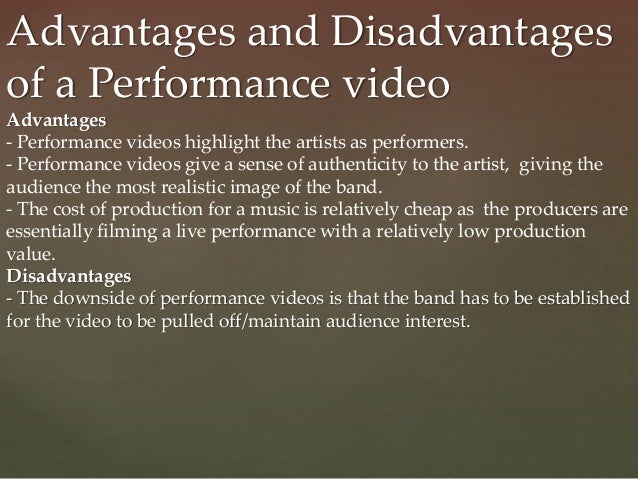
Performance based videos feature the band/artist performing either to the camera or an audience. this is a popular technique rock bands use as there concerts are usually high energy and there is more interest for a viewer to watch the band perform as a whole rather than an artist on their own. The most common type was a theory thought up by Simon Firth in 1988 was to feature the star or group singing in concert to wildly enthusiastic fans; The general goal is to convey a sense of the in- concert experience. Jon Gow (1992) suggests "the predominance of performance indicates that music video defines itself chiefly by images of artists singing and playing songs."

Wednesday, 11 June 2014

CourseWork Project

For the inspirational promotional video we decided to split it into two parts. At the beginning we decided to take it slow to aid the audience slowly into the school and in terms of cameras shots the beginning be would be very slow paced and the audio would be No Angels by Bastille ft Ella Eyre. The song its self is very motional and even though it is slow it is also very uplifting.

Year 13

Thursday, 3 April 2014

What have I learnt about the film production processes?

Nokia N8 used to Film "Olive"
With the technological revolution that introduced many different technology in which the consumer could access easily all at a prices in which are becoming more reasonable. It means that smaller companies are able to have the platform (e.g youtube) to share their productions bring and broad land of opportunity. For example to get some audience feedback for my production, I put it onto youtube and was able to get outside opinions of what worked and what didnt work so well.

In 2011, the first feature film shot entirely on a Smartphone was screened at a West Hills cinema in Los Angeles. Olive, by director Hooman Khalili, was filmed solely on a Nokia N8 and thanks to its cinema run, qualifies for Academy Award consideration. Olive is a reminder that the traditional days of filmmaking are now behind us. The film industry today is in a constant state of change, with a wealth of new opportunities available for those with their finger on the pulse. Thanks to rapidly evolving digital technology, film making and distribution is undergoing a major revolution. Avenues such as YouTube, web series and smart phone applications are all viable- and often lucrative- methods of getting work into the public eye.

In the past, short film makers were lucky to have their work seen by a few hundred festival goers. These days, however, YouTube channels make it easy for filmmakers to broadcast their work to a worldwide audience. Whilst numerous directors run their own channels, collectives such as the Young Irish Film Makers host channels showcasing a number of different artists. Festivals like Sundance also broadcast pieces via this medium. YouTube has also played host to numerous exciting social media ventures, including India’s 2011 Dirt is Good film competition. The project, sponsored by a local laundry brand, invited young filmmakers the chance to work with Bollywood professionals to produce their own short films. In addition to being aired in more than 400 cinemas across India, the winning pieces are now featured on the competition’s YouTube channel. In their first week of broadcast, the films attracted more than 120,000 views, with the number increasing to 330,000 within a month.

So to conclude I have learnt that the film industry is changing at a rate rapidly increasing each day. The technological revolution has brought with it software, like linear editing which 20 years ago was unheard of and who knows; in the next 10 years linear editing may be a thing of the past too. The film industry has been directly affected by the digital revolution in both positive and negative ways. The film industry is a lot more complicated than I thought initially, with production and distribution process being more than meets the eye.